
The old clips made people laugh, gasp, and argue in comment sections. Boston Dynamics Robot Capabilities now matter for a different reason: American companies want machines that can walk through plants, unload trailers, scan gauges, carry parts, and return useful data without turning the workplace upside down. That shift is bigger than a new demo. It is the move from “look what it can do” to “what problem does it remove by Friday?” For readers tracking technology shifts that reach everyday work, the story is not about robot dogs dancing or humanoids doing backflips. It is about dull, tiring, risky jobs that cost money when done late or done wrong. Spot is already positioned for sensing and inspection, Stretch has been used in DHL warehouse unloading, and Atlas is being aimed at industrial work rather than household chores. The hype is loud, but the real test is quiet: a night shift, a hot warehouse, a hard-to-reach gauge, and a manager asking whether the machine earned its keep.
The Real Shift Is From Stunts to Dirty, Repeated Work
A viral robot clip has one job: make you stop scrolling. A working robot has a harder job. It must survive dust, noise, bad lighting, narrow paths, awkward boxes, Wi-Fi dead zones, and people who do not have time to babysit a machine. That is where the Boston Dynamics story has changed. The company is still known for motion that looks almost strange because it is so lifelike, yet the business case now sits in places most people never film.
Why Viral Movement Was Only the First Test
The early fascination made sense. A robot that can recover its balance, climb steps, or move across broken ground feels different from a fixed factory arm behind a fence. Those clips showed control, sensing, and mechanical design in a way anyone could understand. No spreadsheet needed.
Still, movement alone does not pay for the machine. A plant manager in Ohio or Texas does not buy a robot because it looks athletic. They buy it when a machine can inspect a pump room at 2 a.m., keep a worker away from a hazardous area, or gather the same reading every day without drifting from the route.
That is the less flashy truth. The robot’s “body” gets attention, but the work comes from repeatability. A machine that walks beautifully but cannot deliver consistent data is a showpiece. A machine that walks well enough and reports the right thermal image, pressure reading, or inspection note becomes part of operations.
Industrial Inspection Robots Are Where the Story Gets Practical
Spot’s strongest real-world fit is not acting like a pet. It is acting like a mobile sensing platform. Boston Dynamics describes Spot as a machine for automated sensing, inspection, data capture, and work in places where teams need safer, more predictable operations. The company also points to factory floors, construction sites, research labs, and hazardous situations as areas where Spot can extend a team’s reach.
That matters because many American worksites are full of “small” checks that become expensive when missed. A gauge that trends in the wrong direction. A leak that starts behind a unit. A sound that changes near a motor. A hot spot on electrical gear. These are not dramatic tasks, but they are the kind that keep plants running.
The counterintuitive part is that the robot may win by being less exciting. A good inspection robot should become boring. It should take the route, capture the reading, flag the strange result, and stay out of the way. Once workers stop gathering around it, the machine is closer to doing its real job.
Where Boston Dynamics Robot Capabilities Create Real Value
The best use cases are not the ones that ask robots to act human for the sake of it. They are the jobs where the physical world is too awkward for software alone and too repetitive, risky, or costly for people to handle the same way forever. That is why the company’s current product mix matters. Spot, Stretch, and Atlas point to three different kinds of work: inspection, unloading, and flexible industrial handling.
Warehouse Automation Robots Solve a Pain People Feel in Their Shoulders
Trailer unloading sounds simple until you stand inside the trailer. It is hot in summer, cold in winter, and hard on backs, wrists, and knees. Boxes arrive in messy walls. Some lean. Some fall. Some are crushed. The job demands pace, but the space gives workers little room to move.
Stretch attacks that narrow problem instead of pretending to do everything in the warehouse. In the DHL case study, Boston Dynamics describes Stretch as a robot used to automate trailer unloading and support warehouse associates. The system takes pictures of boxes, picks them with suction, places them on a conveyor, and keeps adjusting when a box falls or the scene changes.
That focus is smart. Many warehouse automation robots fail in the imagination stage because people expect one machine to roam, pick, pack, sort, load, clean, and fix errors. Stretch is more serious than that. It works on a painful slice of the warehouse where the value is easier to see: fewer manual lifts, steadier flow, and less chaos when inbound freight arrives late.
Humanoid Robots in Manufacturing Need a Narrow First Win
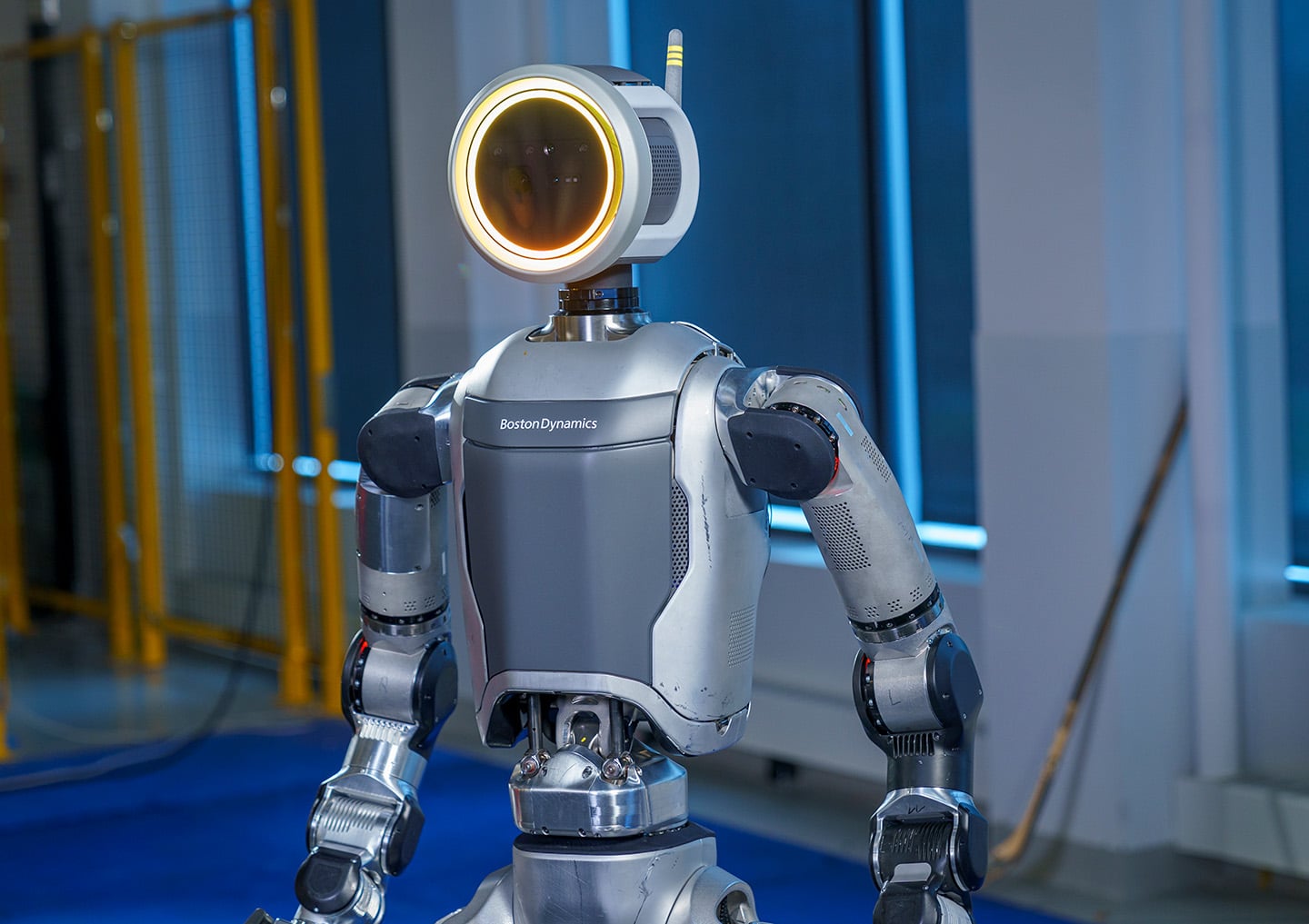
Atlas gets the most attention because it looks closest to the future people were promised. The newer electric Atlas is being positioned for enterprise and industrial work, with material handling as a core theme. Boston Dynamics lists features tied to plant use, including barcode scanning, workflow connections, fleet learning, self-swappable batteries, and links into systems such as MES and WMS.
That does not mean humanoid robots in manufacturing will flood every plant next year. The first serious wins will likely be narrow. Parts sequencing. Machine tending. Order building. Moving items between workstations where the space was built for human bodies instead of fixed automation.
The non-obvious point is that a humanoid robot’s value may come from avoiding construction, not from looking human. If a factory does not need to rip out floors, rebuild lines, or redesign every station, the robot has a better chance. The shape matters because the workplace already has shelves, carts, handles, buttons, and pathways sized for people.
Why Adoption Still Moves Slower Than the Videos
A demo can move fast because the scene is controlled. Adoption moves slower because the workplace is alive. People cross paths. Pallets block lanes. Lighting changes. A supervisor calls out. A maintenance worker opens a panel. A robot that handled the task yesterday may face a messier version tomorrow. That gap between “performed once” and “trusted daily” explains why real deployment takes longer than public excitement.
Safety Is Not a Checkbox After the Sale
Robots often take on hazardous or repetitive work, but they can also introduce new hazards when they are poorly integrated. OSHA says industrial robots are used for tasks such as material handling, assembly, welding, machine loading, painting, spraying, and similar work. It also warns that many robot accidents happen during non-routine conditions such as maintenance, testing, setup, or adjustment, when workers may enter the robot’s working area. OSHA robotics safety guidance gives employers a useful starting point for those risks.
Warehouses add another layer. OSHA’s warehousing guidance notes that automation can create struck-by and caught-between hazards when tools are not properly integrated. It also says workers should understand unique risks around industrial robots.
This is why a robot rollout is never only a robot purchase. It is training, lockout steps, floor markings, access rules, emergency stops, maintenance routines, and worker trust. The machine may be advanced, but the failure point is often plain: a person assumes the robot is off, a path is blocked, or a team never agreed who owns the exception.
Integration Costs Hide Behind the Sticker Price
The purchase price gets attention, but the deeper cost is change. A facility has to decide where the robot charges, who checks it, what data it sends, which alerts matter, and what happens when it gets stuck. That work is less glamorous than a launch video, yet it decides whether the machine survives past pilot testing.
Think of a food plant using industrial inspection robots. The robot may walk the route, but someone must map the route, define what “normal” looks like, decide what images to keep, connect alerts to maintenance software, and train workers to trust the data. Without that, the machine becomes another dashboard people ignore.
The counterintuitive insight is that adoption slows down when the robot is too flexible. A machine that can do many things tempts teams to keep changing the goal. The better path is often a dull first use case with a clear owner, a clear schedule, and a clear measure of success. Boring wins budgets.
What Real Jobs Will Look Like in American Worksites
The next phase will not feel like a movie scene. It will look like a warehouse associate steering a robot to a trailer door, a utility team reviewing thermal images from a night route, or a manufacturing engineer teaching a humanoid robot one repeatable handling task. The future arrives as a shift change, not a grand reveal.
The Worker Becomes a Robot Lead, Not a Bystander
The fear around robots often starts with replacement. Some jobs will change, and some tasks will disappear. Pretending otherwise sounds fake. But in many early deployments, the more realistic shift is from direct labor to robot direction, exception handling, and maintenance-aware judgment.
At DHL, workers described using a tablet and controls that felt familiar, even comparing the experience to game controllers. The detail matters because adoption depends on whether the tool feels usable on a hard day, not whether engineers admire it in a lab.
That is where AI robotics trends for business should be read with a practical eye. A worker who once unloaded trailers may become the person who positions the machine, clears exceptions, watches flow, and catches damage patterns. A technician who once walked every inspection route may spend more time investigating the readings that changed. The job does not vanish in one clean line. It bends.
The Best Robots Will Be Judged by Fewer Surprises
A robot in a real job should reduce surprise. Fewer missed inspections. Fewer emergency repairs. Fewer late unloads. Fewer workers sent into areas where heat, noise, gas, height, or repetitive strain make the day worse. That is the standard American buyers will care about after the novelty fades.
Atlas shows where the ambition is headed. Boston Dynamics lists a 50 kg instant weight capacity, 30 kg sustained capacity, 56 degrees of freedom, tactile sensing, a 360-degree camera view, and a design aimed at enterprise material handling. It also says Atlas is being tested with Hyundai for real-world sequencing tasks and may expand toward machine tending and order building.
Still, the best question is not “Can it do something amazing?” The better question is “Can it do one useful thing every day with fewer errors than the old process?” That is also why workplace automation planning should start before the robot arrives. The route, task, safety case, data flow, and human backup plan are the real job description.
Conclusion
The most interesting part of this shift is not that robots are becoming more mobile, stronger, or more lifelike. It is that companies are learning where those traits matter. A robot that dances earns attention. A robot that unloads a trailer, checks a gauge, or carries parts through a plant earns a place in the budget.
Boston Dynamics Robot Capabilities will keep drawing views, but the next test is patience. American employers will ask whether the machine fits the floor, protects workers, reports useful data, and keeps working when the scene gets messy. That is a harder standard than applause, and it is the standard that separates a demo from a tool.
The winners will not be the companies that buy robots first. They will be the ones that define the job with care, train people well, and treat automation as a work system instead of a magic trick. Start there, and the robot has a fair chance to become part of the shift instead of a visitor on the floor.
Frequently Asked Questions
What jobs can Boston Dynamics robots do now?
Spot is used for inspection, sensing, data capture, and work in hazardous or hard-to-reach areas. Stretch focuses on trailer unloading in warehouses. Atlas is being aimed at industrial material handling tasks such as sequencing, machine tending, and order building.
Are Boston Dynamics robots replacing warehouse workers?
They are more likely to replace certain hard tasks than entire jobs at first. Trailer unloading, repeated inspection routes, and risky checks are strong targets. Workers still handle setup, exceptions, maintenance coordination, quality judgment, and decisions the robot cannot make alone.
Why is robot adoption slower than viral videos suggest?
Videos show one successful task. Worksites demand repeat performance across dust, clutter, bad lighting, blocked paths, training needs, safety rules, and software connections. A company must prove the robot saves time or risk after the excitement fades.
Is Spot a security robot or an inspection robot?
Spot can be fitted for different uses, but its strongest business case is inspection and sensing. It can walk routes, gather images, carry payloads, and help teams monitor equipment or areas that are tiring, unsafe, or difficult for people to check often.
What makes Stretch useful in warehouses?
Stretch is built around a narrow but painful job: unloading boxes from trailers. It can identify boxes, pick them with suction, place them on a conveyor, and adjust when boxes move or fall. That focus makes the value easier to measure.
Are humanoid robots in manufacturing ready for everyday use?
They are moving closer, but broad use will take time. The strongest early applications are likely controlled industrial tasks with repeatable motions, clear workflows, and limited surprises. Factories will need training, safety planning, and careful task design before wide use.
What should a company check before buying workplace robots?
Start with the task, not the machine. Check safety risk, floor layout, charging space, data needs, staff training, maintenance support, and how success will be measured. A narrow job with a clear owner is better than a broad wish list.
Why do Boston Dynamics robots matter beyond entertainment?
They show how mobile machines can enter places built for people, not only fenced factory cells. That opens new options for inspection, warehouse work, and industrial handling. The value comes when motion, sensing, software, and worker training solve a real daily problem.